From Marketing Data to Action
Designing an AI-assisted workflow that helps small e-commerce owners turn marketing data into an evidence-backed next step.
Interactive Figma prototype
- Context
- BrainStation AI Product Management course project
- Team
- Parisa Sharifpour & Vastal Rastogi
- Validation status
- Evaluation planned; business impact not yet validated.
From reporting to a decision.
Small business owners have access to marketing reports but often struggle to understand what deserves attention and what to do next. We explored an AI-assisted product that brings Shopify sales and Meta advertising data into a structured decision workflow.
The proposed experience moves from data upload to performance-change detection, evidence review, a decision brief, and a suggested next step.
More dashboards do not necessarily lead to clearer decisions.
Owners may see declining sales or changing advertising performance without knowing whether to adjust their budget, investigate their website, or gather more information. Our initial interviews surfaced difficulty interpreting dashboards, understanding advertising’s contribution to sales, and making decisions with limited time and incomplete information.
Small e-commerce businesses already running paid digital ads.
We selected this segment as the initial target. Shopify and Meta CSV exports provide a focused starting point for exploring the workflow without requiring live integrations.
The segment’s willingness to adopt and pay for this solution remains to be validated.
An intentionally focused MVP.
Focus on a decision brief
The proposed value is helping owners choose their next step, rather than adding another reporting dashboard.
Start with CSV uploads
This keeps the initial scope manageable and allows us to test the experience before investing in integrations.
Separate calculations from interpretation
Metrics and comparisons should be calculated deterministically. AI should explain those results using the available evidence.
Make uncertainty visible
A performance change does not prove its cause. The experience should distinguish observations, possible explanations, and missing information.
Keep the owner in control
Recommendations require review. The proposed MVP does not automatically change advertising budgets or campaigns.
A workflow built around the next step.
- 01
Upload data
The owner uploads Shopify and Meta CSV exports.
- 02
Review performance changes
The product highlights meaningful differences between reporting periods.
- 03
Investigate evidence
The owner reviews supporting metrics, possible explanations, and gaps in the available data.
- 04
Read the decision brief
A concise summary explains what changed, what the evidence supports, and what remains uncertain.
- 05
Choose a next step
The owner reviews a suggested action or further investigation.
Interactive Figma prototype
Explore the proposed journey from uploading marketing data to reviewing performance changes, investigating evidence, and choosing a next step.
This prototype demonstrates the proposed experience. It does not process live data, run an AI model, or change advertising campaigns. If Figma cannot load here, the direct link above remains available.
The journey, screen by screen.
Original Figma screenshots with illustrative sample data—not live results or validated business outcomes.
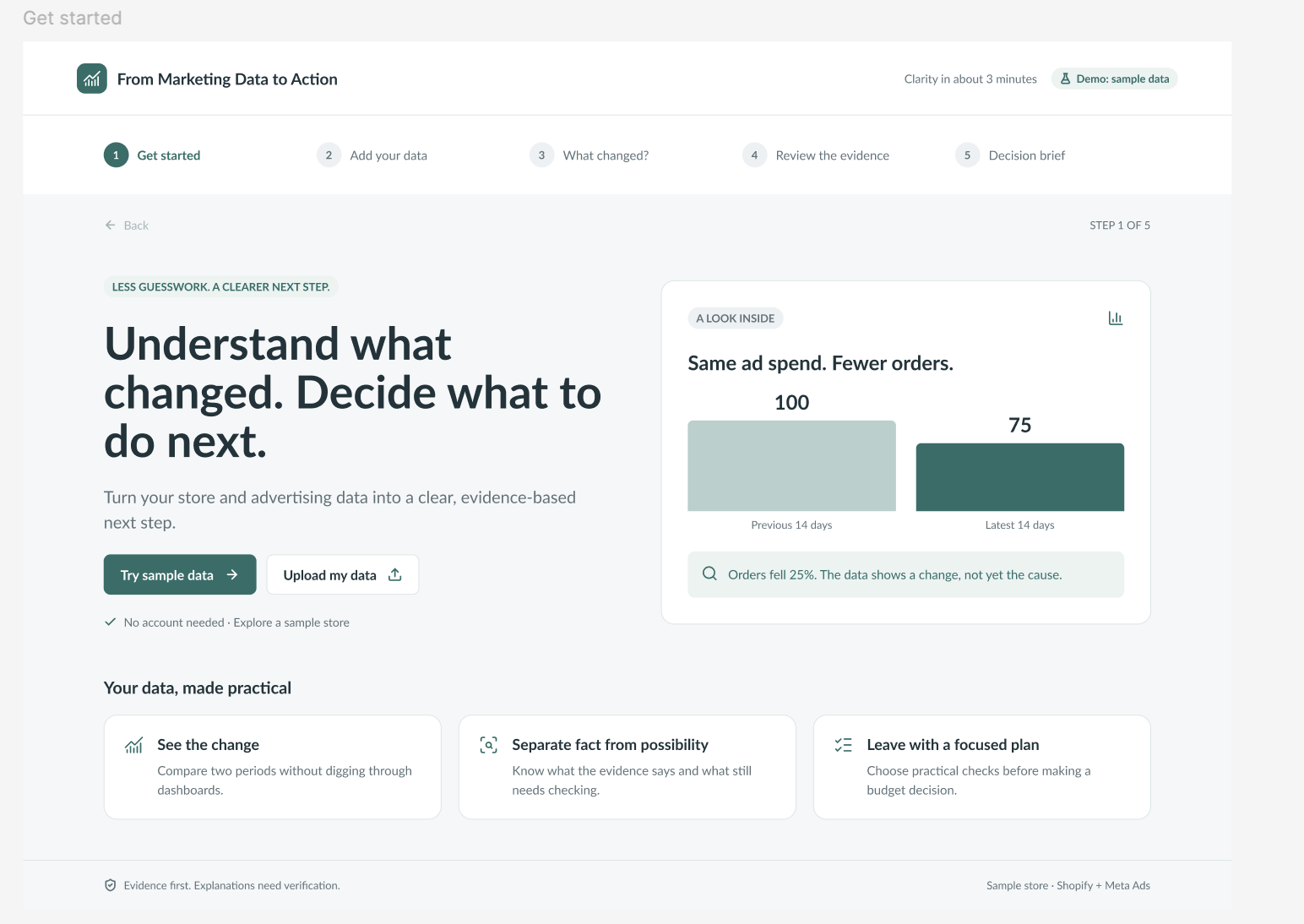
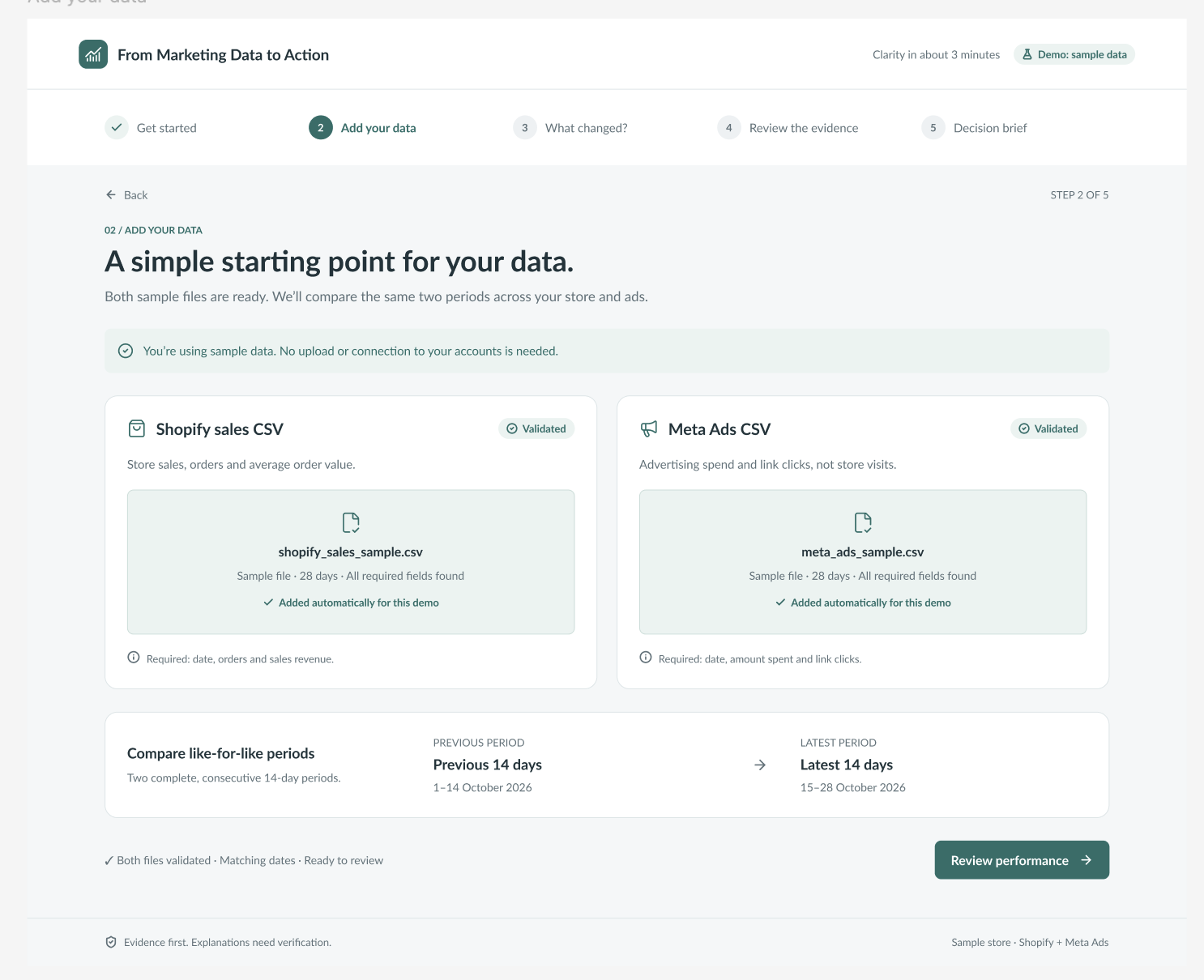
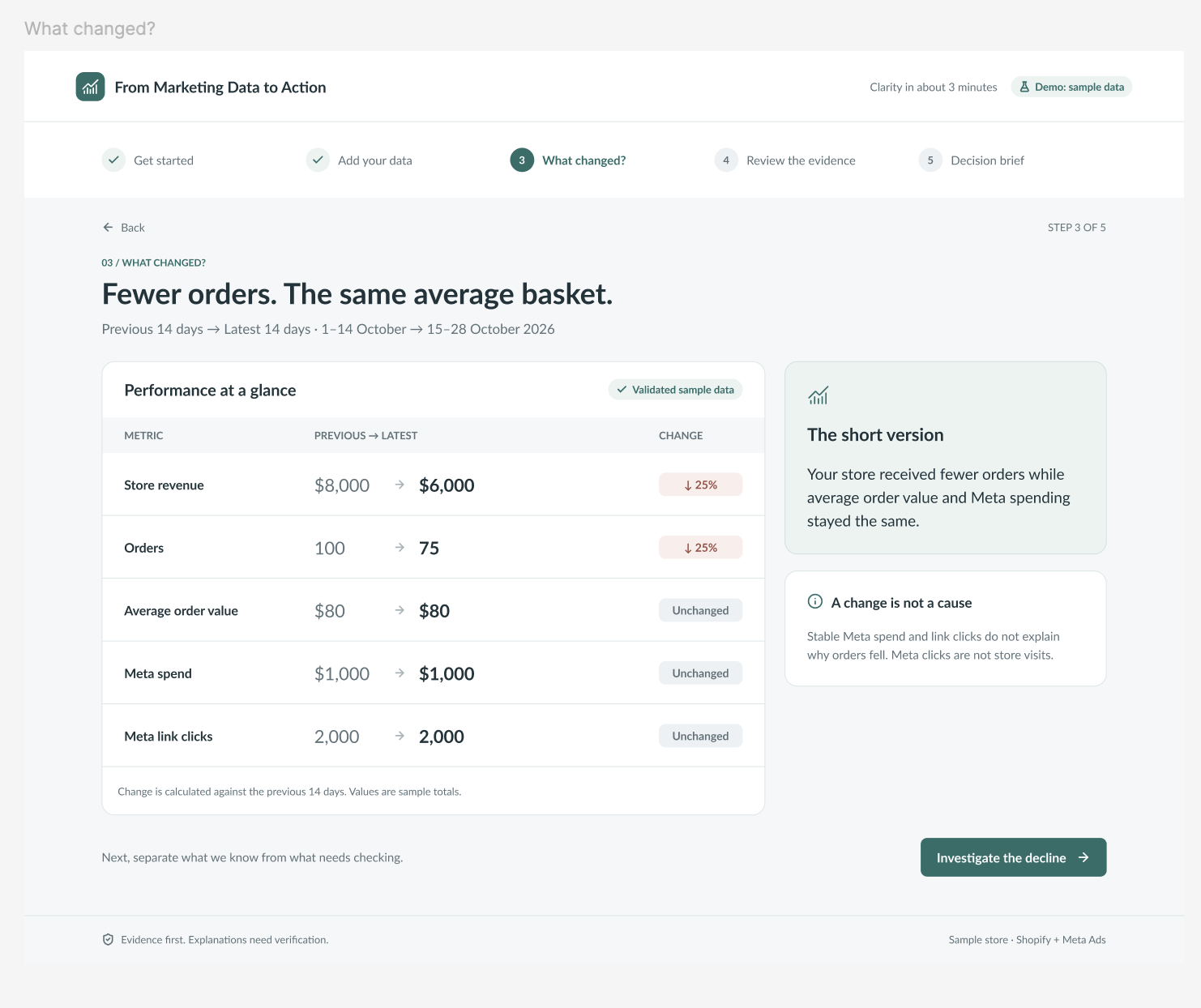
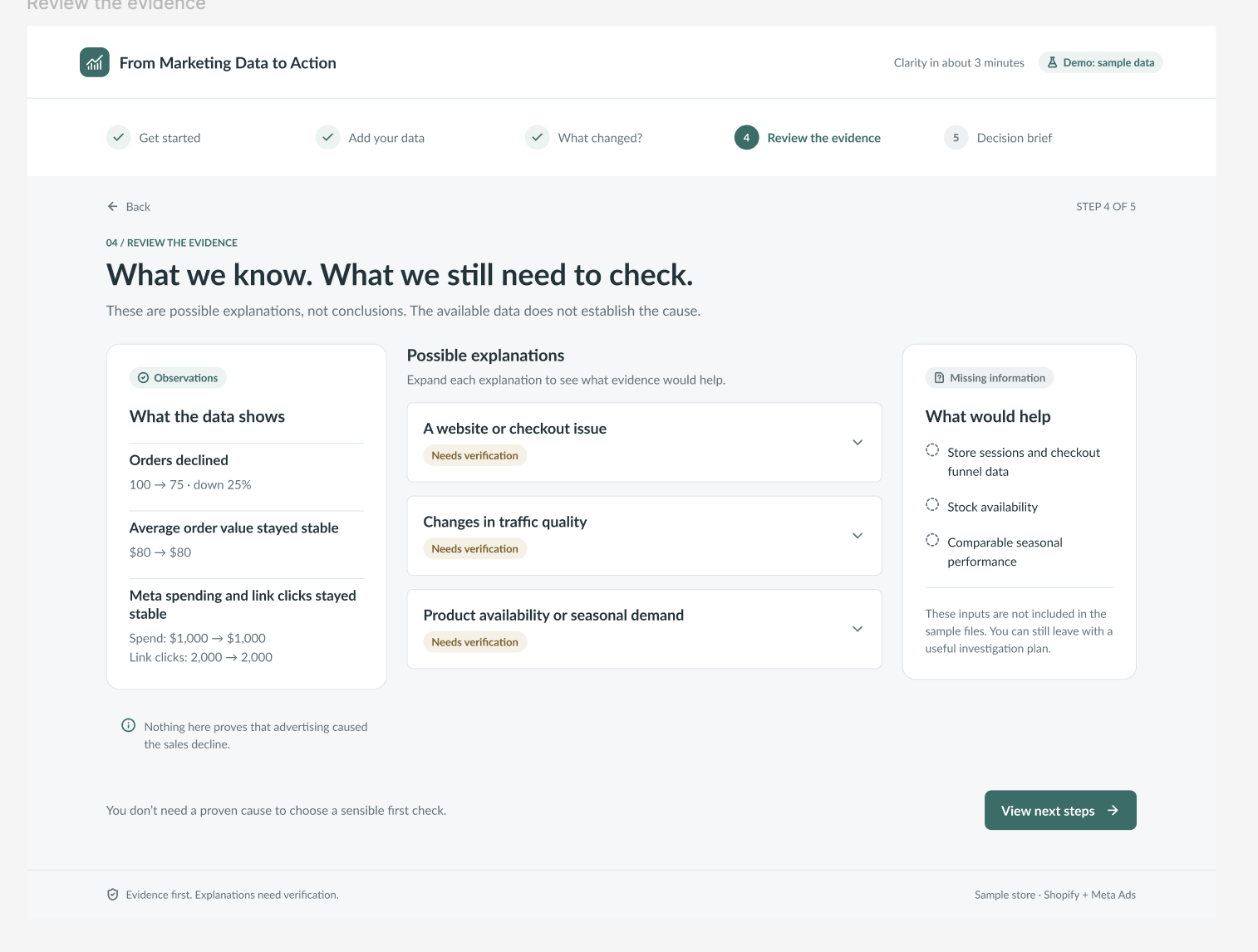
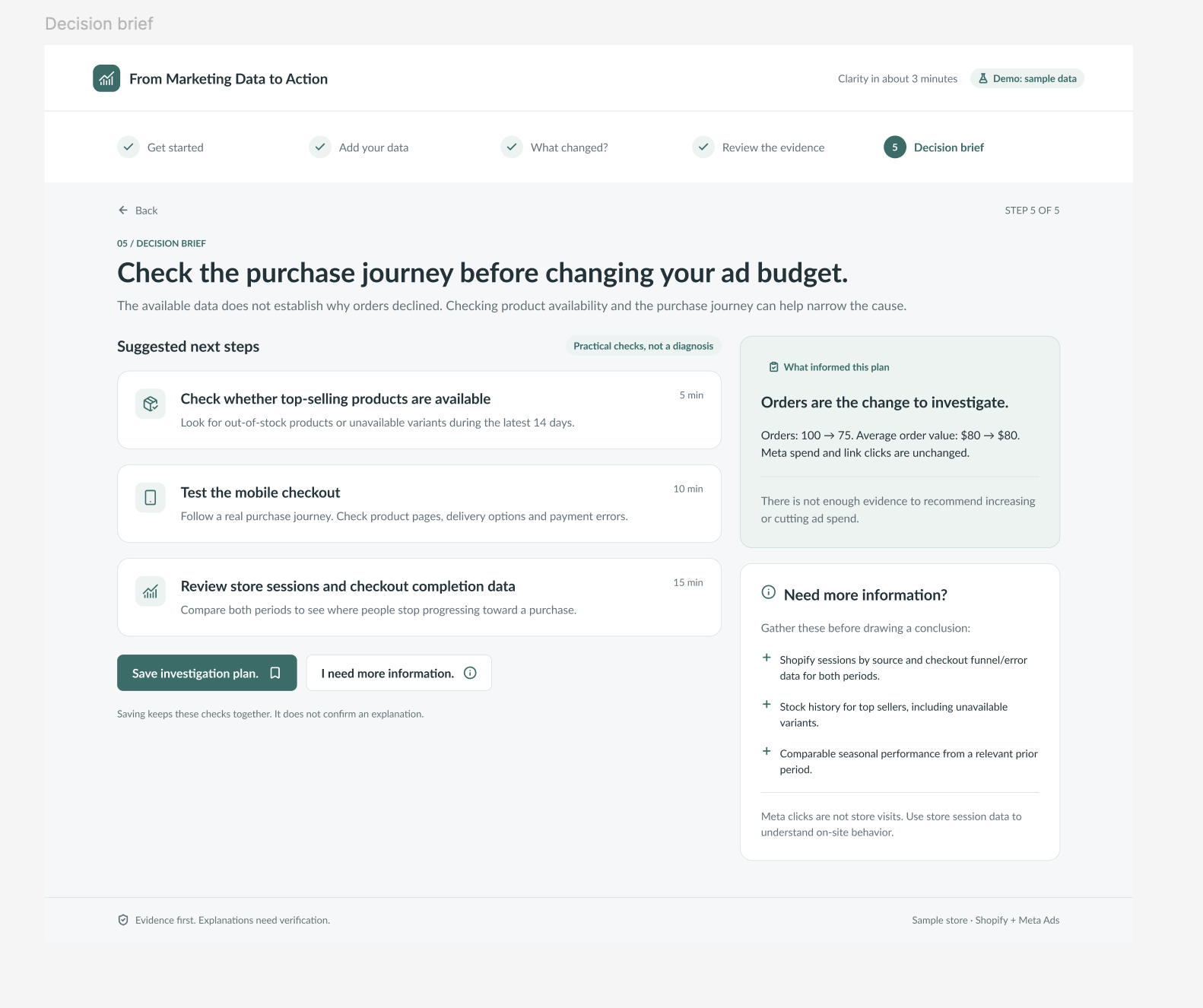
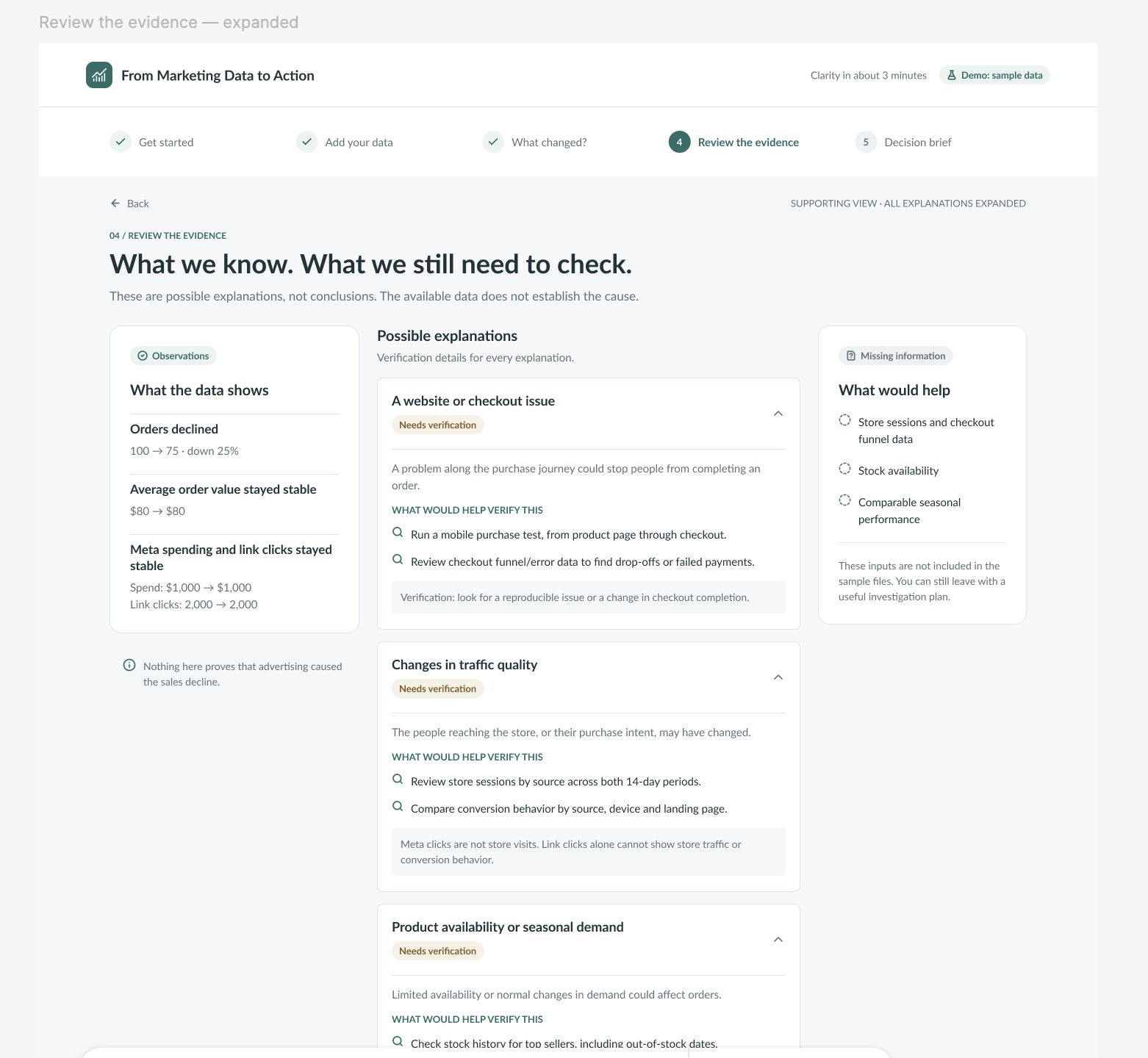
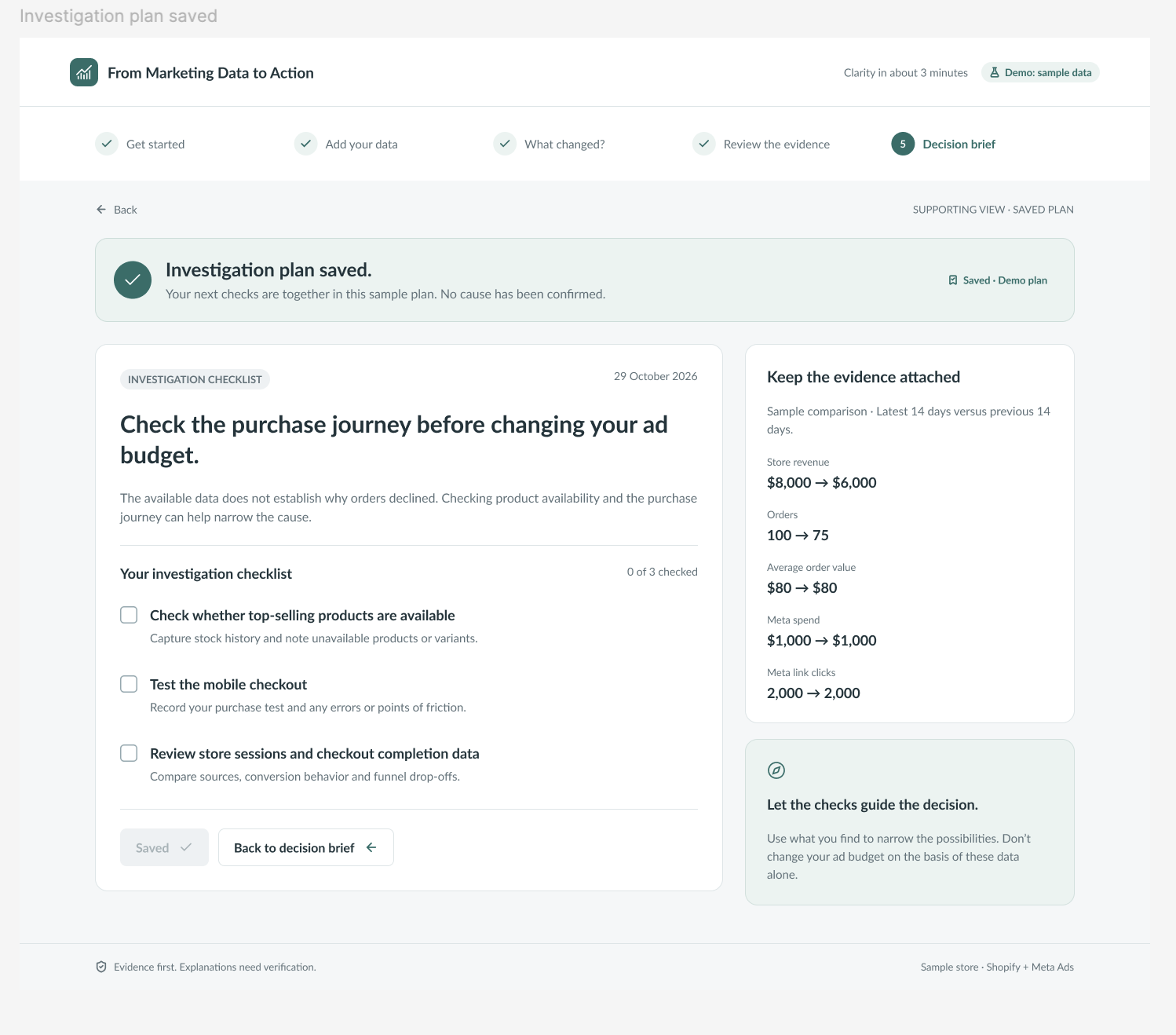
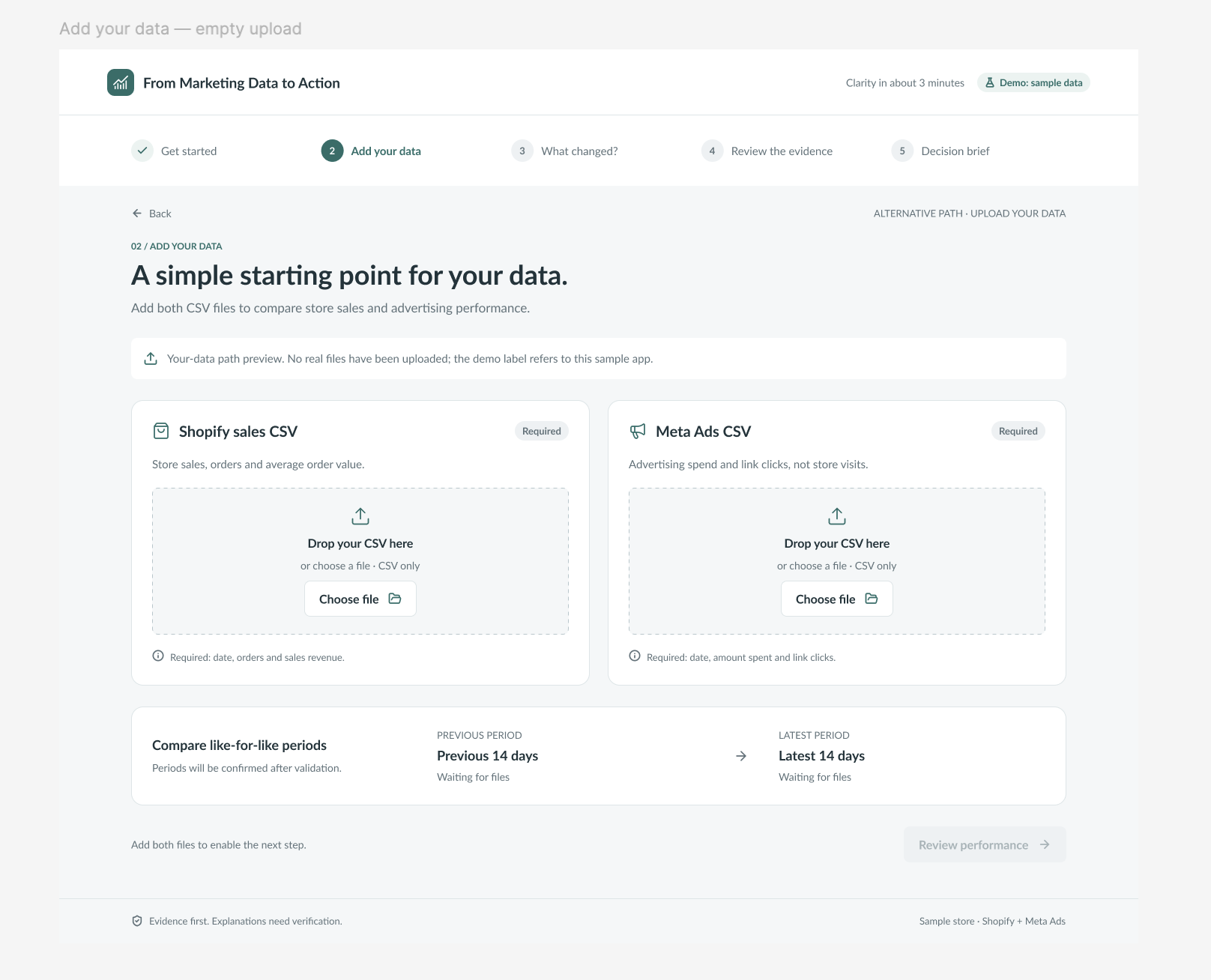
Calculate the facts. Interpret the evidence. Review the action.
The intended workflow combines automated checks, deterministic metrics, evidence-grounded AI summaries, structured recommendations, and human review. These are proposed product behaviors, not implemented capabilities demonstrated by Figma.
Input checks
Automated checks for missing or inconsistent data.
Deterministic calculations
Metrics and comparisons between reporting periods.
AI interpretation
Summaries grounded in supplied evidence; recommendations with uncertainty and supporting information.
Human review
Owner review before action, with no automatic campaign or budget changes in the proposed MVP.
Make uncertainty visible.
- Separate facts from hypotheses.
- Trace factual claims to supplied data.
- Show missing information and limitations.
- Avoid unsupported causal explanations.
- Recommend investigation when evidence is insufficient.
- Require owner approval before campaign or budget changes.
Measure recommendation quality, not just polished explanations.
The key hypothesis is that a structured, evidence-backed brief will help owners make better-informed decisions than a generic AI recommendation.
- Comprehension
- Can owners distinguish observations from possible explanations?
- Evidence quality
- Are factual claims and recommendations supported by the data?
- Action appropriateness
- Is the suggested next step reasonable given the evidence and uncertainty?
- Usability
- Can owners complete the journey and explain what they would do next?
- Comparative value
- Does the structured brief provide more useful guidance than a generic AI response to the same data?
Numerical accuracy and evidence support should be assessed against a predefined rubric. Target users should assess clarity and usefulness. These are planned evaluations, not completed results.
A recommendation is only useful if it fits the evidence.
The main challenge is defining and measuring recommendation quality. A polished AI explanation is only useful if its claims are supported and its proposed action fits the evidence.
Next steps are to run prototype testing, refine the evaluation rubric, compare outputs with a generic AI baseline, and use the findings to prioritize a working MVP.